
 0
 Boss
Boss: The Labyrinth Pathfinder


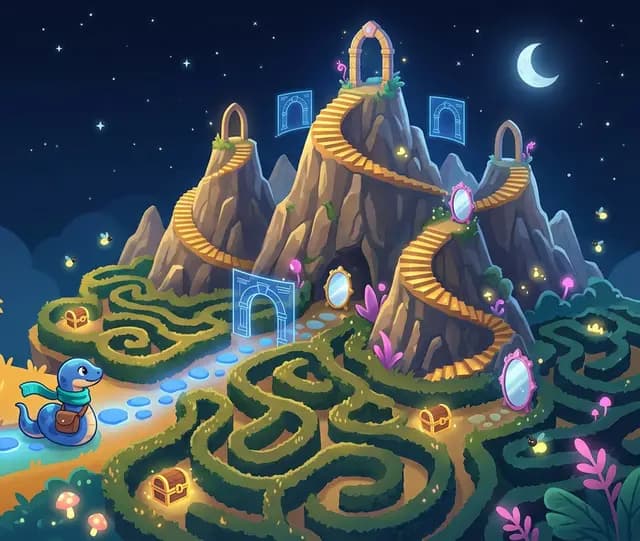
Beneath the Old Lighthouse lies the Labyrinth, and the last dark lantern hangs at its exit. Pip needs the shortest route, because the torch won't last forever.
The map is a list of strings: S is the start, E the exit, # a wall and
. open floor. You may step up, down, left or right.
From distances to a path
In Ripples on a Grid you used BFS to count steps. The shortest path itself needs one more idea. When BFS finds a new square, write down which square it came from:
came_from = {start: None}   # also marks "found"
...
came_from[nxt] = pos        # we reached nxt from pos
When BFS reaches E, walk backwards: E, then came_from[E], then
the square before that, until you hit None at the start. Reverse
that list and you have the path from S to E.
Assignment
Positions are (row, col) tuples.
Build it in three steps:
find(grid, char): return the position of the firstchar, orNoneif it isn't on the map.neighbors(grid, pos): return a list of the open (not#) positions up, down, left and right ofposthat are inside the grid. (You saw this helper in Ripples on a Grid.)shortest_path(grid): usefindto getSandE. Run BFS with adequeand acame_fromdict. When you popE, rebuild the path and return it as a list of positions fromStoE(both included). If the queue runs out first, returnNone.
Press Run to try your code, then Check to test it.